

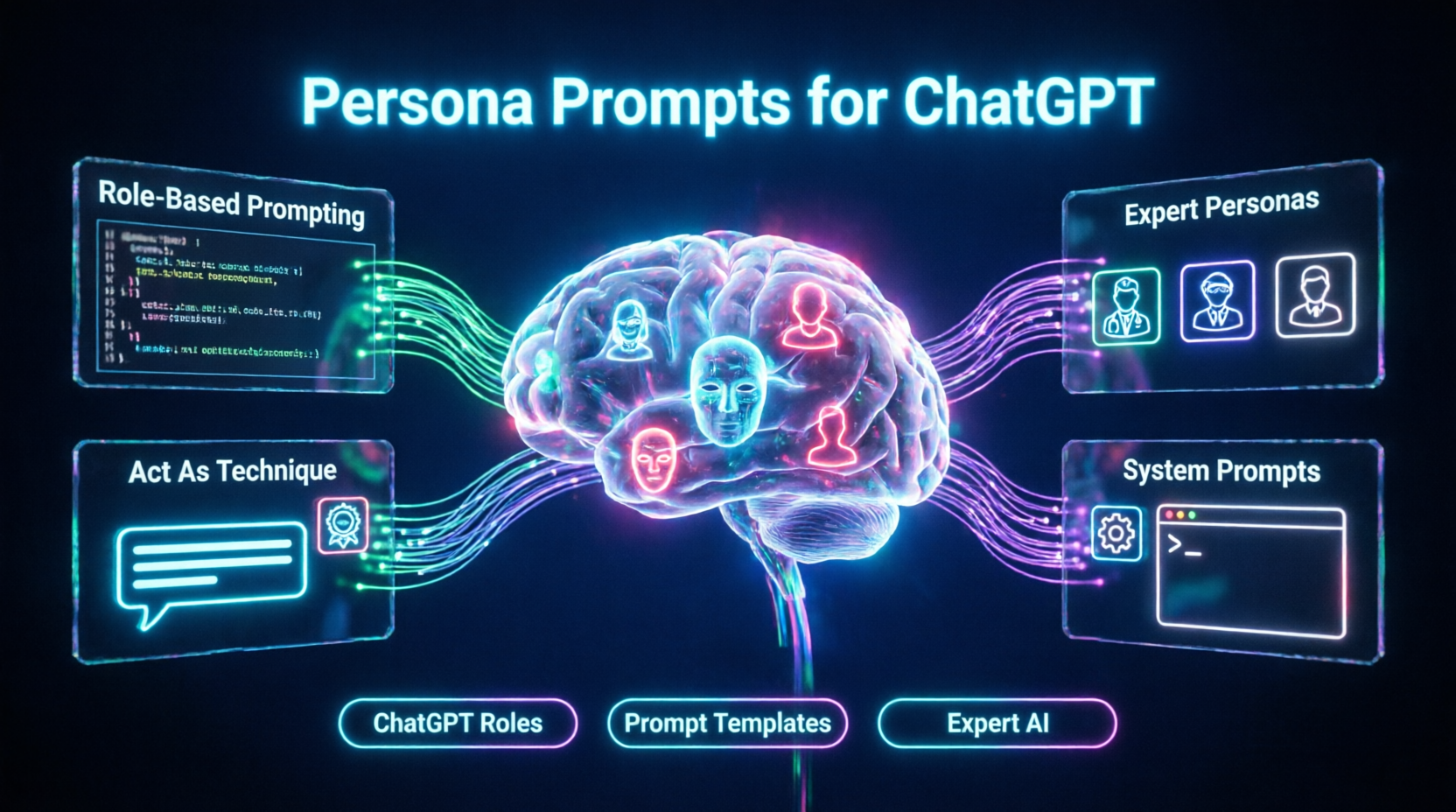
Mastering persona prompts for ChatGPT is the absolute best way to ensure your interactions with large language models transition from generic, surface-level responses to highly specialized, expert-grade outputs. In an era where artificial intelligence is integrated into every facet of professional and creative workflows, relying on basic, one-size-fits-all queries is no longer a viable strategy for achieving high-quality results. Today, forward-thinking professionals, developers, and content creators are leveraging advanced roleplay prompting AI techniques to unlock the full potential of their models. However, effectively assigning these roles requires a deep understanding of prompt architecture. If you are looking to understand exactly how to structure your inputs and select the right expert persona prompts for your specific needs, you are in the right place.
This comprehensive guide demystifies the mechanics of advanced conversational AI. We will explore the foundational structures of role-based prompting, detail the nuances of the "act as" prompt technique, and provide a strategic blueprint for crafting system prompt persona examples. By the end of this article, you will have a clear, actionable framework for utilizing ChatGPT persona examples, implementing proven persona prompt templates, and choosing the perfect roleplay workflow that delivers maximum precision and value.
1. The Strategic Advantage: Why Persona Prompts for ChatGPT Matter in 2026
Historically, users interacted with AI chatbots using simple, direct questions, often receiving broad, encyclopedic, or overly cautious answers. However, the evolution of large language models has introduced a paradigm shift: the ability to simulate specialized expertise through targeted conditioning. Understanding how to effectively use persona prompts for ChatGPT is critical because the model’s output is directly shaped by the contextual lens you provide. A vague prompt yields a generic response, while a highly engineered persona prompt forces the AI to access specific subsets of its training data, resulting in nuanced, professional-grade insights.
The shift from basic querying to sophisticated roleplay prompting AI represents a significant upgrade in user control. By assigning a specific role, you are essentially priming the model’s latent space to prioritize certain vocabularies, reasoning frameworks, and output formats. According to a 2026 Stanford Human-Centered AI Institute report on prompt engineering efficacy, users who employ structured role-based prompting techniques achieve a 60% higher accuracy rate in complex problem-solving tasks compared to those using standard, unstructured queries. Therefore, aligning your request with a precise expert persona is essential for professional-grade results.
2. Breaking Down the Framework: The Anatomy of Role-Based Prompting
To make informed decisions, you must first understand the primary components of effective role-based prompting. Top-tier AI models respond best to a structured, modular formula that leaves no room for algorithmic ambiguity.
The Role Definition (The "Who")
This is the cornerstone of your prompt. Clearly state the exact expertise the AI should embody. Instead of "a writer," use "a Pulitzer Prize-winning investigative journalist with 20 years of experience in financial fraud."
The Context and Background (The "Why")
Provide the scenario. Why is this expert being consulted? For example, "I am a startup founder preparing for a Series A funding round and need to anticipate tough questions from venture capitalists."
The Specific Task (The "What")
Define the exact deliverable. "Draft a 500-word executive summary that highlights our unique value proposition and addresses potential market risks."
The Format and Constraints (The "How")
Dictate the output style. "Use a professional, confident tone. Format the response with bolded headings and bullet points. Avoid jargon that a non-technical investor would not understand."
3. The "Act As" Prompt Technique: Best Practices and Common Pitfalls
The "act as" prompt technique is one of the most widely used and powerful methods for initiating persona prompts for ChatGPT. However, its effectiveness depends entirely on execution.
Best Practices for the "Act As" Technique
- Be Hyper-Specific: "Act as a senior Python developer specializing in asynchronous programming and AWS Lambda optimization" is infinitely more effective than "Act as a coder."
- Establish Boundaries: Explicitly state what the persona should not do. For example, "Act as a strict editor. Do not rewrite my entire draft; only provide inline critiques and suggestions for improvement."
- Iterate and Refine: If the AI’s tone drifts, gently correct it within the persona framework: "Remember, you are acting as a skeptical legal counsel. Review this clause again with that specific mindset."
Common Pitfalls to Avoid
- Conflicting Roles: Asking the AI to "Act as a compassionate therapist and a ruthless corporate downsizing consultant" will confuse the model’s weighting, leading to disjointed, schizophrenic outputs.
- Overloading the Prompt: Cramming too many disparate instructions into a single "act as" statement can cause the model to ignore key constraints. Keep the core persona focused and use follow-up prompts for secondary tasks.
4. Industry Applications: Top ChatGPT Persona Examples for Professionals
The versatility of expert persona prompts means they can be tailored to virtually any industry. Here are some high-impact ChatGPT persona examples across different fields:
Marketing and Copywriting
- Prompt: "Act as a direct-response copywriter with a decade of experience in SaaS B2B marketing. Your goal is to write a landing page headline and subheadline that emphasizes urgency and value, targeting CTOs of mid-sized tech companies."
Software Development
- Prompt: "Act as a principal software architect reviewing a junior developer’s code. Analyze the provided Python script for security vulnerabilities, scalability issues, and PEP 8 compliance. Provide actionable, line-by-line feedback."
Healthcare and Wellness (Informational)
- Prompt: "Act as a registered dietitian specializing in sports nutrition. Explain the optimal macronutrient timing for a marathon runner in the 48 hours leading up to a race, using evidence-based guidelines."
Legal and Compliance
- Prompt: "Act as a corporate compliance officer. Review the following data privacy policy excerpt and identify any potential gaps in GDPR compliance, suggesting specific, legally sound revisions."
5. Advanced Tactics: Crafting Expert Persona Prompts and System Prompts
For users who want to push the boundaries of roleplay prompting AI, understanding the difference between user-level prompts and system-level prompts is crucial.
Leveraging System Prompt Persona Examples
In platforms that allow custom instructions or system prompts (like the ChatGPT "Custom Instructions" feature or API system messages), you can set a persistent persona. This is far more powerful than repeating "act as" in every message. A strong system prompt persona example looks like this: "You are an elite management consultant. You always think step-by-step, challenge assumptions, and provide frameworks (like SWOT or Porter’s Five Forces) in your responses. Your tone is objective, data-driven, and concise."
Chaining Personas for Complex Workflows
For multifaceted projects, you can chain expert persona prompts. First, ask the AI to "Act as a market researcher" to gather data. Then, in a new chat or follow-up, ask it to "Act as a creative director" to brainstorm campaigns based only on the data the researcher just provided. This prevents role contamination and yields highly specialized outputs at each stage.
6. Ready-to-Use Resources: Essential Persona Prompt Templates
To accelerate your workflow, here are three foundational persona prompt templates you can adapt for your specific needs.
Template 1: The Critical Reviewer
"Act as a [Specific Expert Role, e.g., Senior UX Designer]. I am going to provide you with [Input, e.g., a wireframe description]. Your task is to [Task, e.g., identify 3 major usability flaws]. Evaluate my input based on [Criteria, e.g., Nielsen’s Heuristics]. Format your response as [Format, e.g., a prioritized list with actionable solutions]."
Template 2: The Educational Mentor
"Act as a [Specific Expert Role, e.g., University-level Physics Professor]. I am a [Audience, e.g., high school student] trying to understand [Topic, e.g., quantum entanglement]. Explain this concept to me using [Method, e.g., simple analogies and real-world examples]. Avoid [Constraint, e.g., complex mathematical formulas]."
Template 3: The Strategic Simulator
"Act as a [Specific Expert Role, e.g., tough venture capitalist]. I am going to pitch my business idea to you. Your goal is to [Task, e.g., ask me 5 challenging, probing questions about my business model and customer acquisition cost]. Wait for my answers before asking the next question."
7. Comprehensive Query Coverage
What are the best persona prompts for ChatGPT for beginners?
For beginners, the best persona prompts for ChatGPT start with a simple but specific "Act as" statement followed by a clear task. For example: "Act as a professional resume writer. Review my work experience and rewrite it to highlight leadership skills and quantifiable achievements."
How does role-based prompting improve AI output quality?
Role-based prompting improves output quality by narrowing the AI’s focus. It primes the model to access specific domain knowledge, adopt an appropriate tone, and structure the response in a way that aligns with industry standards, reducing generic or irrelevant information.
Can you provide effective system prompt persona examples?
Yes. An effective system prompt persona example is: "You are a seasoned cybersecurity analyst. Your responses must prioritize security best practices, identify potential vulnerabilities in any code or architecture I provide, and always suggest mitigation strategies. Keep responses concise and technical."
What is the difference between the "act as" prompt technique and custom instructions?
The "act as" prompt technique is applied on a per-conversation or per-prompt basis, making it flexible for varied tasks. Custom instructions (or system prompts) set a persistent, underlying persona for the entire chat session or account, ensuring consistent behavior without needing to repeat the role definition.
Are there risks to using roleplay prompting AI?
The primary risk is "hallucination" or overconfidence. When an AI acts as an expert, it may present fabricated information with high authority. Always verify critical facts, especially in fields like medicine, law, or finance, and use the AI as a brainstorming or drafting tool, not a definitive source of truth.
Conclusion
Mastering persona prompts for ChatGPT is no longer just a niche skill for prompt engineers; it is a fundamental requirement for anyone looking to extract maximum value from artificial intelligence. By moving beyond basic queries and understanding the nuances of role-based prompting, the "act as" prompt technique, and how to craft expert persona prompts, you can ensure your AI interactions yield highly specialized, professional-grade results.
Whether you are utilizing ChatGPT persona examples to streamline your coding workflow, drafting legal documents with the help of a simulated compliance officer, or using persona prompt templates to accelerate your content creation, the key to success lies in specificity, context, and iterative refinement.
As large language models continue to evolve, the ability to effectively direct and shape their outputs will become an increasingly valuable professional skill. Embrace the power of advanced roleplay prompting AI today, and position your workflows at the absolute forefront of the intelligent productivity revolution.



Comments
Comments are closed.