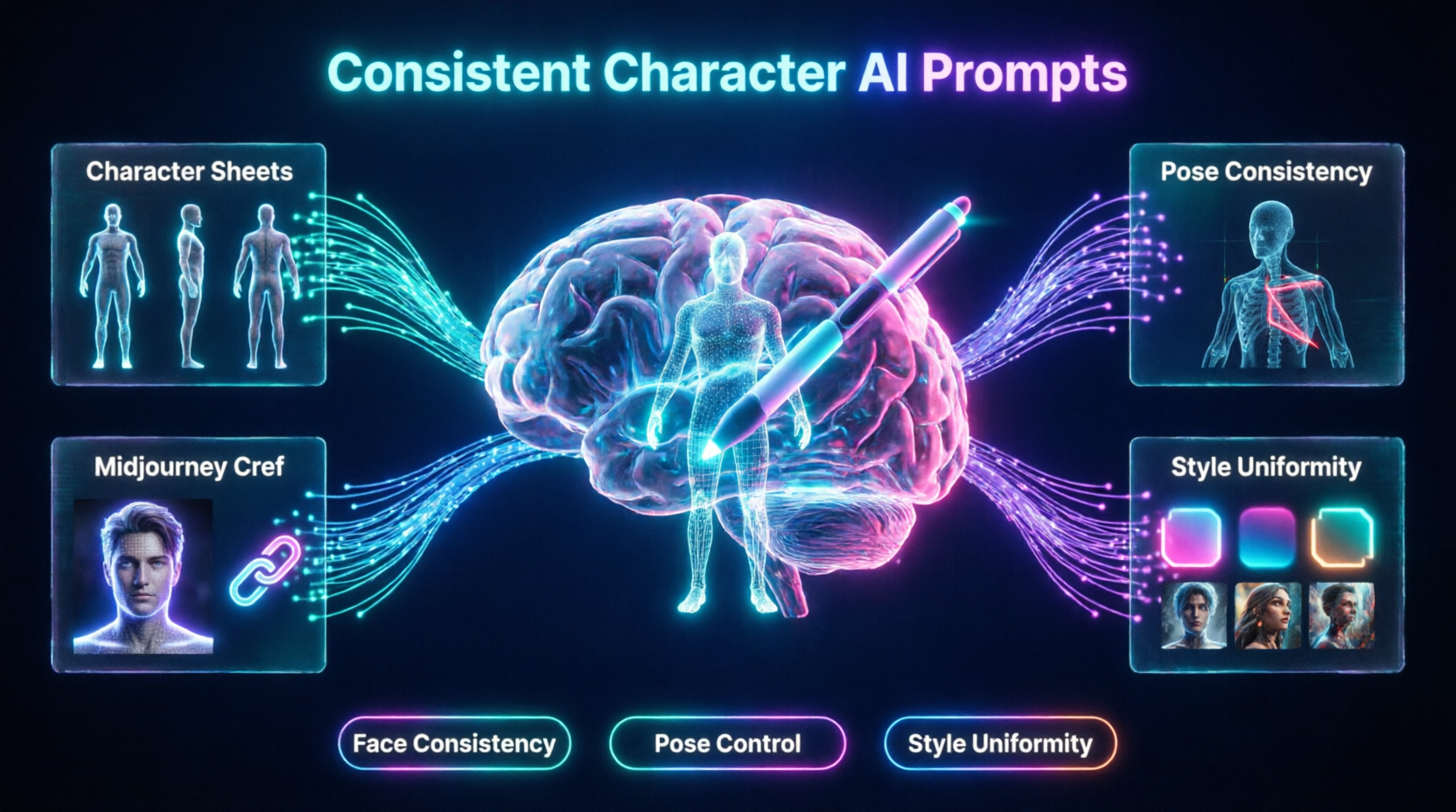
Mastering consistent character AI prompts is the absolute best way to ensure your digital art projects, graphic novels, and storyboards maintain visual continuity without the frustrating "identity drift" that plagues early generative models. In an era where AI-generated content is increasingly used for professional storytelling, game development, and marketing, relying on random, unseeded generations is no longer a viable strategy for cohesive visual narratives. Today, forward-thinking artists and creators are leveraging advanced prompting techniques and platform-specific features to lock in facial features, clothing, and artistic styles across multiple images. However, achieving this level of control requires a deep understanding of prompt engineering. If you are looking to understand exactly how to structure your inputs and utilize reference tools to maintain perfect uniformity, you are in the right place.
This comprehensive guide demystifies the technical landscape of generative character design. We will explore the foundational structures of AI character design prompts, detail how to achieve character consistency in Midjourney and other top platforms, and provide a strategic blueprint for crafting character sheet AI prompts. By the end of this article, you will have a clear, actionable framework for generating the same character in different poses, utilizing character reference prompts, and choosing the right consistent character generator prompts that deliver maximum creative control.
1. The Creative Challenge: Why Consistent Character AI Prompts Matter in 2026
Historically, the greatest limitation of text-to-image AI was its inherent randomness. You could generate a stunning portrait of a "cyberpunk detective with blue hair," but asking for that same character in a different scene would yield a completely different person with similar traits. This "identity drift" made AI useless for sequential art, comic books, or branded marketing campaigns.
However, the evolution of latent diffusion models and the introduction of advanced parameters have introduced a paradigm shift. Understanding how to write consistent character AI prompts is critical because it transforms AI from a random idea generator into a reliable production tool. According to a 2026 State of AI Art Report, professional illustrators who utilize structured character reference techniques and consistent prompting workflows report a 70% reduction in revision time and a significantly higher rate of client approval for AI-assisted projects. Aligning your creative vision with these precise methodologies is essential for professional-grade visual storytelling.
2. Breaking Down the Formula: Core Elements of AI Character Design Prompts
To make informed creative decisions, you must first understand the primary components of effective AI character design prompts. Top-tier models respond best to a highly structured, modular formula that leaves no room for algorithmic guesswork.
The Anchor Description
This is the immutable core of your character. It must be highly specific and repeated in every prompt. Instead of "a young woman," use "a 25-year-old female protagonist, sharp jawline, freckles across the nose, emerald green eyes, short asymmetrical silver bob haircut."
The Stylistic Modifiers
Define the art style, medium, and rendering engine. Use terms like "cel-shaded anime style," "hyper-realistic digital painting, ArtStation trending," or "vintage 1990s comic book style, bold ink lines." Keeping this consistent ensures the world looks the same, even if the character's angle changes.
The Environmental Context
Describe the setting, lighting, and camera angle. For example, "standing in a neon-lit rainy alleyway, cinematic rim lighting, low angle shot, 85mm lens."
3. Mastering the Tools: Achieving Character Consistency Midjourney & Beyond
Not all AI platforms handle consistency the same way. Evaluating the model requires understanding the specific tools available to lock in your character's identity.
Character Consistency Midjourney
Midjourney has revolutionized this space with its --cref (Character Reference) parameter. By appending --cref [URL] to your prompt, you can feed the AI a reference image of your character. Adjusting the Character Weight (--cw) from 0 to 100 allows you to dictate whether the AI should copy just the face (--cw 0) or the face, hair, and clothing (--cw 100). This is currently the gold standard for maintaining character consistency that Midjourney users rely on.
Stable Diffusion and ControlNet
For users demanding absolute, pixel-level control, Stable Diffusion paired with ControlNet (specifically IP-Adapter and Reference-Only models) is unmatched. It allows creators to feed a source image and strictly dictate the pose, depth, and facial identity of the output, making it the preferred choice for professional AI storyboard character consistency.
DALL-E 3
While DALL-E 3 lacks direct image-to-image character referencing, it excels at strict textual adherence. By giving the character a highly unique, memorable name and repeating a dense, detailed physical description in every prompt, you can achieve a reasonable degree of consistency for simpler, stylized projects.
4. The Blueprint: How to Create Effective Character Sheet AI Prompts
Before animating or placing your character in a story, you need a master reference. Crafting effective character sheet AI prompts is the foundational step for any serious project.
The Turnaround Prompt Structure
A classic character sheet prompt should explicitly request multiple angles. Use phrasing like: "A character design sheet of [Character Description], featuring three views: front view, side profile view, and back view. Neutral expression, standing in a T-pose. White background, flat lighting, concept art style, highly detailed."
Expression and Variation Sheets
Once the base design is locked, generate an expression sheet. Prompt: "A character expression sheet of [Character Description], showing four distinct facial expressions: happy, angry, surprised, and sad. Close-up on the face, consistent character design, white background, vector art style."
Isolating the Elements
To ensure the AI doesn't blend elements, use negative prompts. Add --no background, shadows, multiple characters, varying styles to force the model to focus purely on the character's design uniformity.
5. Action in Motion: Generating the Same Character in Different Poses with AI
Static character sheets are only half the battle. The true test of consistency is placing that character into dynamic action while retaining their identity.
Leveraging Pose References
The most reliable method for generating the same character in different poses AI is to combine a character reference (--cref) with a pose reference. In Midjourney, you can use the --sref (Style Reference) or external tools to map a specific skeleton pose to your generated character.
Descriptive Action Prompting
When writing the prompt, be explicit about the biomechanics of the pose. Instead of "running," use "dynamic action pose, sprinting forward, left leg extended, arms pumping, motion blur, low camera angle." The more specific the physical description, the less the AI has to "hallucinate" the anatomy, which helps preserve the facial features.
Iterative Inpainting
If the AI gets the pose right but warps the face, use inpainting tools. Mask the face and re-roll just that specific area with a prompt emphasizing "consistent face, [Character Name]'s exact features," until the identity snaps back into place.
6. Advanced Techniques: Utilizing Character Reference Prompts and Seeds
For creators who want to push the boundaries of AI storyboard character consistency, advanced technical parameters are your best friends.
The Power of Seed Numbers
Every AI generation has a "seed" number, which is the initial noise pattern. If you find a generation that is 90% perfect, reuse that exact seed number in your next prompt, changing only the action or environment. This keeps the underlying "DNA" of the image identical, drastically improving consistency.
Training Custom LoRAs (Low-Rank Adaptation)
For ultimate, long-term projects (like a 100-page graphic novel), consistent character generator prompts might not be enough. Training a custom LoRA model on 15-20 consistent images of your character allows you to summon that exact character with a simple trigger word (e.g., "char_john_doe") in Stable Diffusion, guaranteeing near-perfect uniformity every time.
Naming Your Character
Surprisingly, giving your character a unique, non-dictionary name (e.g., "Zylara" instead of "Sarah") helps the AI treat the name as a specific visual token rather than blending it with millions of existing images of "Sarah" in its training data.
7. Comprehensive Query Coverage
What are the best consistent character AI prompts for beginners?
For beginners, the best consistent character AI prompts rely on highly detailed, repetitive text descriptions combined with a fixed art style. Focus on defining 3-4 immutable physical traits (e.g., "red curly hair, scar on left cheek, green jacket") and repeat them exactly in every prompt.
How do I achieve character consistency in Midjourney?
To achieve character consistency in Midjourney, generate a base image you love, get its URL, and use the --cref [URL] parameter in your new prompts. Pair this with --cw 100 to copy the face and clothing, or --cw 0 to copy only the facial features while allowing the AI to change the outfit.
What makes a good character sheet AI prompt?
A good character sheet AI prompt explicitly requests multiple angles (front, side, back) or expressions on a plain, neutral background. It uses keywords like "character turnaround," "model sheet," "T-pose," and "flat lighting" to prevent the AI from adding complex, distracting environments.
Can I generate the same character in different poses with AI without paid tools?
Yes, though it is more challenging. You can use free platforms like Bing Image Creator (DALL-E 3) and rely on highly specific, repetitive text prompts and unique character names. However, for professional results, tools with image-to-image referencing (like Midjourney or Stable Diffusion) are highly recommended.
How do character reference prompts improve AI storyboard character consistency?
Character reference prompts provide the AI with a visual anchor. Instead of trying to translate a text description into an image from scratch every time, the AI uses the reference image to map the exact facial geometry, color palette, and proportions onto the new scene, ensuring seamless continuity across storyboard panels
Conclusion
Mastering consistent character AI prompts is no longer just a niche skill for prompt engineers; it is a fundamental requirement for digital artists, game developers, and storytellers alike. By moving beyond basic text inputs and understanding the nuances of character consistency Midjourney offers, how to build a character sheet AI prompt, and the power of character reference prompts, you can ensure your visual narratives are cohesive, professional, and compelling.
Whether you are trying to generate the same character in different poses for a dynamic action sequence or establishing a brand mascot with perfect AI storyboard character consistency, the key to success lies in combining detailed textual descriptions with the advanced technical parameters of modern AI tools.
As artificial intelligence continues to evolve, the barrier to creating complex, multi-scene visual narratives will continue to drop. Embrace the power of precise, consistent character generation today, and position your creative projects at the absolute forefront of the automated visual revolution.



Comments
Comments are closed.