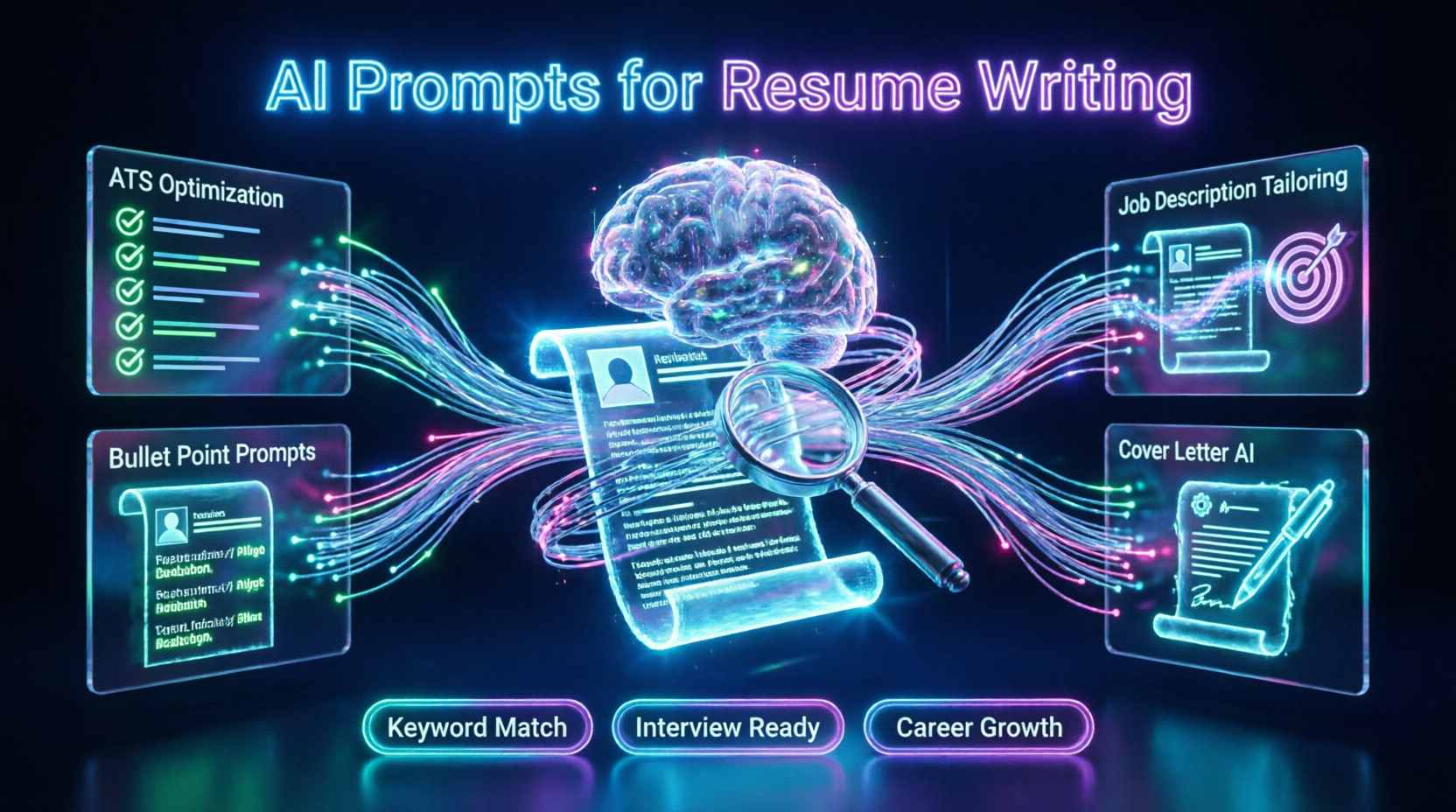
Mastering AI prompts for resume writing is the absolute best way to ensure your job applications bypass automated gatekeepers and land directly on the desk of hiring managers. In an era where over 90% of Fortune 500 companies use Applicant Tracking Systems (ATS) to filter candidates before a human ever sees their application, relying on outdated, generic resume templates is no longer a viable strategy for career advancement. Today, forward-thinking job seekers are leveraging advanced AI prompts for resume writing to craft highly optimized, keyword-rich, and impact-driven documents. However, simply asking an AI to "write my resume" often results in generic, easily flagged text. If you are looking to understand exactly how to structure your inputs and select the right ATS-friendly resume prompts to secure more interviews, you are in the right place.
This comprehensive guide demystifies the intersection of artificial intelligence and modern recruitment technology. We will explore the foundational mechanics of ATS-friendly resume prompts, detail how to craft powerful resume bullet point prompts, and provide a strategic blueprint for using the tailor resume to job description prompt. By the end of this article, you will have a clear, actionable framework for utilizing ChatGPT resume examples, mastering the professional summary AI prompt, and choosing the perfect AI resume builder prompts that deliver maximum interview conversion rates.
1. The ATS Gatekeeper: Why AI Prompts for Resume Writing Matter in 2026
Historically, job seekers wrote resumes primarily for human readers, focusing on creative layouts and narrative flow. However, the modern hiring landscape is dominated by Applicant Tracking Systems (ATS)—complex algorithms that parse, rank, and filter applications based on keyword matching, formatting compliance, and semantic relevance. Understanding how to leverage AI prompts for resume writing is critical because the gap between candidates who optimize for these algorithms and those who do not is the difference between landing an interview and facing automatic rejection.
The shift from manual resume tweaking to AI-assisted, data-driven optimization represents a monumental upgrade in job search efficiency. Modern AI prompts for resume writing do not just generate text; they analyze job descriptions to extract critical keywords, restructure your experience to match industry standards, and quantify your achievements. According to a 2026 Forbes Career Report on AI in recruitment, job seekers who utilize structured AI prompts for resume writing report a 55% higher callback rate compared to those using traditional, unoptimized resumes. Therefore, aligning your application strategy with precise, algorithm-aware prompting is essential for career success.
2. Decoding the Algorithm: How to Craft ATS-Friendly Resume Prompts
To make informed decisions, you must first understand how ATS software parses text. If your prompt doesn't account for ATS mechanics, the AI might generate a beautifully written but technically unreadable resume.
Standard Section Headings
ATS software looks for specific, standard headings to categorize your information. Your ATS-friendly resume prompts must instruct the AI to use exact headings like "Professional Experience," "Education," "Skills," and "Certifications." Avoid creative headings like "My Journey" or "Where I've Been," which will confuse the parser.
Keyword Extraction and Integration
The core function of an ATS is keyword matching. A strong AI prompt for resume writing will instruct the AI to analyze the target job description, extract the hard skills and industry-specific terminology, and naturally integrate them into your experience section without "keyword stuffing."
Formatting and Parsing Instructions
AI models sometimes try to be too creative with formatting. Your prompts must explicitly forbid the use of tables, text boxes, columns, or complex graphics, as these elements often scramble the text when parsed by an ATS. Instruct the AI to output clean, single-column, reverse-chronological text.
3. The Core Components: Resume Bullet Point Prompts and Professional Summary AI Prompts
The two most critical sections of your resume are the professional summary and the experience bullet points. Using specific resume bullet point prompts and professional summary AI prompts ensures these sections are impactful and optimized.
The "XYZ" Resume Bullet Point Prompt
Generic bullet points like "Responsible for managing a team" will not stand out. Use this prompt to force the AI to quantify your impact:
"Rewrite my resume bullet points using the Google 'XYZ' formula: 'Accomplished [X] as measured by [Y], by doing [Z]'. Use strong action verbs, include specific metrics (percentages, dollar amounts, time saved), and ensure the tone is professional and results-oriented. Here is my raw experience: [Insert Raw Text]."
The Targeted Professional Summary AI Prompt
Your summary is your elevator pitch. It must immediately align you with the role. Use this prompt:
"Write a 3-sentence professional summary for a [Target Job Title] with [Number] years of experience. Highlight my expertise in [Key Skill 1], [Key Skill 2], and [Key Skill 3]. The tone should be confident and tailored to the [Target Industry] industry. Avoid clichés like 'hard worker' or 'team player' and focus on measurable value."
4. Customization is Key: The Tailored Resume to Job Description Prompt
Sending the same generic resume to 50 different jobs is a recipe for failure. The tailor resume to job description prompt is the most powerful tool in your arsenal for customizing your application at scale.
The Ultimate Tailoring Prompt
*"Act as an expert resume writer and ATS optimization specialist. I am going to provide you with my current resume and a target job description.
- Analyze the job description and extract the top 5 hard skills and 3 soft skills required.
- Rewrite my professional summary to align perfectly with these requirements.
- Revise my experience bullet points to highlight the achievements that are most relevant to this specific role, integrating the extracted keywords naturally.
- Identify any critical skills from the job description that are missing from my resume and suggest how I might incorporate them if I have that experience.
- Here is my resume: [Insert Resume]. Here is the job description: [Insert JD]."*
This tailored resume-to-job-description prompt ensures that every application you submit is highly relevant, significantly boosting your ATS match score.
5. Beyond the Resume: AI Cover Letter Prompts and AI Resume Builder Prompts
While the resume gets you past the bot, the cover letter convinces the human. AI cover letter prompts require a different approach, focusing on narrative and cultural fit rather than just keyword matching.
The Narrative AI Cover Letter Prompt
"Write a compelling, one-page cover letter for the [Job Title] position at [Company Name]. Do not just repeat my resume. Instead, tell a brief story about how my experience with [Specific Achievement/Project] directly solves a key challenge mentioned in the job description. Match the company's tone (e.g., innovative, formal, startup-casual) and express genuine enthusiasm for their recent work in [Specific Company Initiative]."
Leveraging AI Resume Builder Prompts
If you are using dedicated AI resume builders (like Teal, Rezi, or Kickresume), your prompts should focus on structural optimization. Use AI resume builder prompts to ask the tool: "Analyze my resume against this job description and provide a match score. Suggest three specific bullet points I can add to increase my keyword match by 15%."
6. Best Practices for Using ChatGPT Resume Examples and Prompts
When utilizing ChatGPT resume examples and prompts, adhering to best practices ensures your output is both high-quality and secure.
Protect Your Personally Identifiable Information (PII)
Never paste your full name, phone number, email, or home address into a public AI chatbot. Replace them with placeholders like "[Name]", "[Phone]", and "[Email]" before prompting.
Iterative Refinement
Do not expect perfection on the first generation. If the AI makes your bullet points too wordy, follow up with: "Make these bullet points 20% more concise and ensure they all start with a unique action verb."
Fact-Checking and Hallucinations
AI can sometimes "hallucinate" metrics or skills you didn't mention to make you look better. Always rigorously fact-check the AI's output. Never claim a skill, certification, or metric that you cannot confidently defend in an interview.
7. Comprehensive Query Coverage
What are the best AI prompts for resume writing for entry-level candidates?
For entry-level candidates, the best AI prompts for resume writing focus on extracting transferable skills from academic projects, internships, and extracurriculars. Use a prompt like, "Translate my university project experience into professional resume bullet points, highlighting skills like project management, data analysis, and teamwork."
How do ATS-friendly resume prompts differ from standard prompts?
ATS-friendly resume prompts explicitly instruct the AI to avoid complex formatting, use standard section headings, integrate exact-match keywords from the job description, and focus on clean, parsable text structures that automated systems can easily read.
Can I use a professional summary AI prompt for a career changer?
Yes. A professional summary AI prompt is highly effective for career changers. Instruct the AI to: "Write a professional summary for a career changer transitioning from [Current Industry] to [Target Industry]. Highlight my transferable skills in [Skill 1] and [Skill 2] and frame my past experience as a unique advantage for this new role."
How often should I use the tailor resume to job description prompt?
You should use the tailor resume to job description prompt for every single high-priority job application. While it takes an extra 5 minutes per application, the resulting increase in your ATS match score and interview callback rate makes it a highly worthwhile investment of your time.
Are AI cover letter prompts effective for getting interviews?
Yes, when used correctly. AI cover letter prompts are highly effective because they help you structure a compelling narrative that connects your past achievements to the company's future needs, saving you hours of writer's block while maintaining a professional, persuasive tone.
Conclusion
Mastering AI prompts for resume writing is no longer just a tech-savvy trick; it is a fundamental requirement for navigating the modern, algorithm-driven job market. By moving beyond basic text generation and understanding the nuances of ATS-friendly resume prompts, the strategic use of the tailor resume to job description prompt, and how to craft impactful resume bullet point prompts, you can ensure your applications consistently bypass the bots and impress the humans.
Whether you are utilizing ChatGPT resume examples to restructure your career history, leveraging a professional summary AI prompt to pivot industries, or using AI cover letter prompts to tell your unique story, the key to success lies in precision, customization, and rigorous fact-checking.
As recruitment technology continues to evolve, the candidates who thrive will be those who know how to speak the language of both the algorithm and the hiring manager. Embrace the power of intelligent resume optimization today, and position your career at the absolute forefront of the modern job search revolution.



Comments
Comments are closed.