

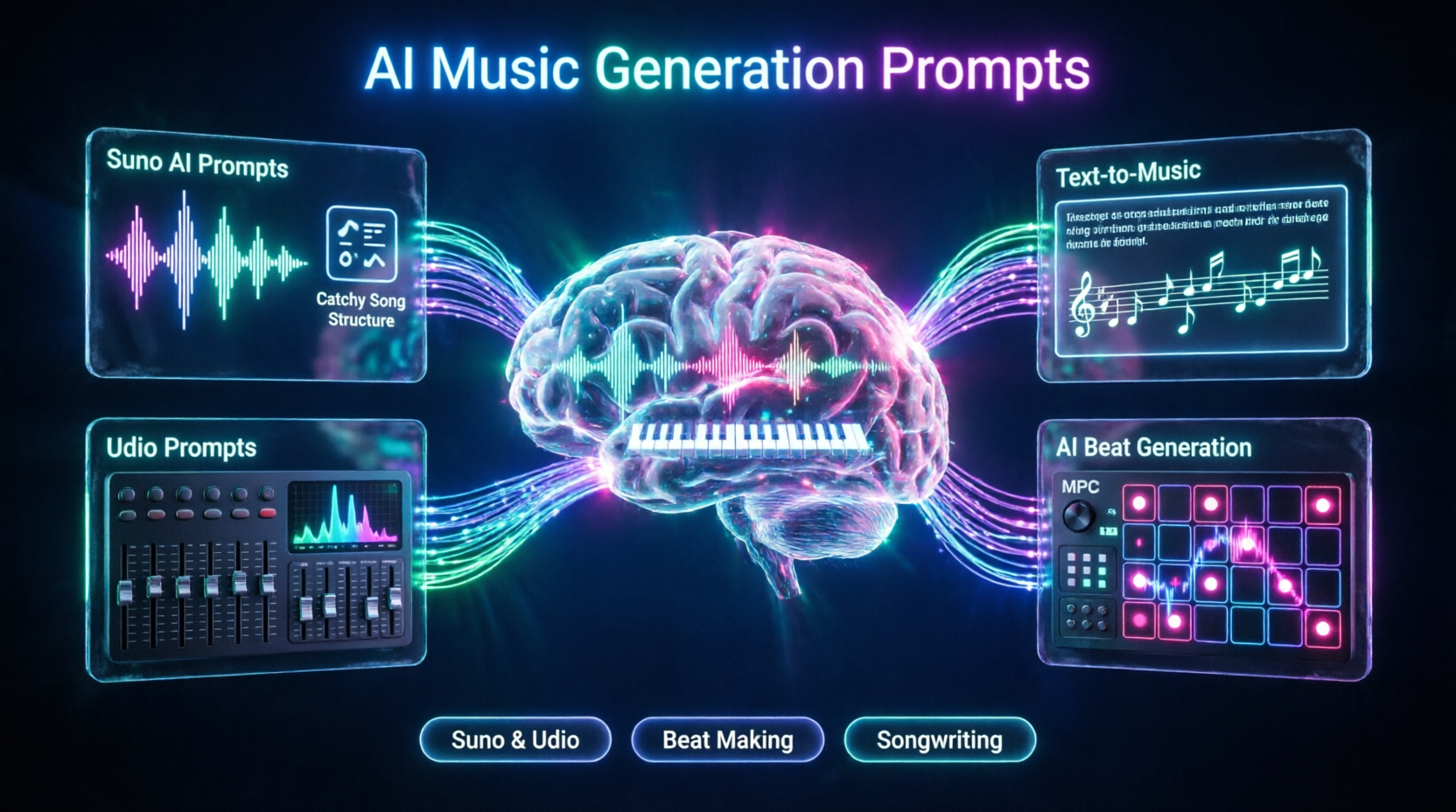
Mastering AI music generation prompts is the absolute best way to ensure your creative audio projects transition from vague musical ideas to fully produced, broadcast-ready tracks without requiring years of formal music theory training or expensive studio time. In an era where content creation spans video, gaming, podcasts, and social media, relying on generic, royalty-free stock music is no longer a viable strategy for standing out. Today, forward-thinking creators, indie artists, and media producers are leveraging advanced neural networks to compose original melodies, generate dynamic beats, and synthesize realistic vocals. However, the transition to AI-assisted music production requires a deep understanding of prompt engineering. If you are looking to understand exactly how to structure your inputs and select the right platform for your sonic vision, you are in the right place.
This comprehensive guide demystifies the creative landscape of generative audio. We will explore the foundational structures of text-to-music AI prompts, detail how to evaluate top AI songwriting tools, and provide a strategic blueprint for crafting AI music prompt examples that rival traditional studio productions. By the end of this article, you will have a clear, actionable framework for writing effective AI song lyrics prompts, mastering AI beat generation prompts, and choosing the perfect generative audio workflow that delivers maximum creative impact.
1. The Creative Landscape: Why AI Music Generation Prompts Matter in 2026
Historically, music production was a highly technical discipline requiring expensive Digital Audio Workstations (DAWs), virtual instruments, and a deep understanding of mixing and mastering. However, the emergence of advanced audio diffusion models and transformer-based architectures has introduced a paradigm shift, allowing creators to generate high-fidelity, structurally coherent music directly from text. Understanding AI music generation prompts is critical because the quality, coherence, and emotional resonance of the output are entirely dependent on the precision of your input. A vague prompt will yield generic, muddy audio, while a highly engineered prompt will produce a polished, radio-ready track.
The shift from early, glitchy audio experiments to production-ready AI songwriting tools represents a significant upgrade in temporal consistency, harmonic accuracy, and vocal realism. Early models struggled with song structure and often devolved into noise. Modern AI, however, utilizes advanced attention mechanisms to understand musical phrasing, rhythm, and genre conventions. According to a 2026 Music Business Worldwide report on generative audio, creators who utilize structured, multi-layered prompting techniques achieve a 65% higher satisfaction rate with their first-generation outputs compared to those using single-sentence inputs. Therefore, aligning your creative vision with a precise prompting methodology is essential for professional-grade results.
2. Breaking Down the Formula: Understanding Text-to-Music AI Prompts
To make informed creative decisions, you must first understand the primary components of effective text-to-music AI prompts. Top-tier audio models respond best to a structured "formula" that leaves no room for algorithmic guesswork.
Genre and Subgenre
Be highly specific. Instead of "rock," use "1990s alternative rock, grunge influence, distorted power chords." The more precise the genre, the better the AI can access the correct training data for instrumentation and production style.
Instrumentation and Tempo
Explicitly state the instruments you want to hear and the speed of the track. For example, "driving 120 BPM, punchy 808 drum machine, warm analog synthesizer bass, crisp acoustic guitar strumming."
Mood and Atmosphere
Lighting dictates the mood in video; in music, it’s the emotional vibe. Use descriptive terms like "melancholic," "ethereal," "uplifting," "aggressive," "cinematic," "lo-fi," and "nostalgic."
Vocal Style and Structure
If you want vocals, specify the gender, tone, and style (e.g., "soulful female vocals, breathy delivery, wide harmonies"). Additionally, modern AI music generation prompts benefit greatly from structural metatags like [Intro], [Verse], [Chorus], [Bridge], and [Outro] to guide the song's progression."
3. Evaluating the Platforms: Suno AI Prompts vs. Udio Prompts
Not all AI audio models are built the same. Evaluating the model requires understanding the specific strengths of industry leaders to match the platform to your project's unique requirements.
Suno AI
Suno is widely celebrated for its incredible ease of use and ability to generate catchy, structurally sound, full-length songs with highly coherent vocals. When writing Suno AI prompts, focus on clear genre definitions, strong emotional themes, and straightforward structural tags. Suno excels at pop, rock, country, and hip-hop, making it the best choice for creators who want a complete, radio-ready song with minimal technical tweaking.
Udio
Udio is renowned for its staggering audio fidelity, complex musical arrangements, and granular control. Udio prompts can be more intricate, allowing for detailed descriptions of production techniques (e.g., "sidechain compression," "reverb-drenched snare," "orchestral swell"). Udio is the best choice for producers, filmmakers, and musicians who demand studio-grade sound quality, intricate instrumental solos, and the ability to extend or remix specific sections of a track.
Other AI Songwriting Tools
Platforms like Stable Audio or Google’s MusicLM are excellent for generating high-quality, instrumental background music, soundscapes, and specific sound effects. They are ideal for video game developers, podcasters, and content creators who need royalty-free, mood-specific background audio without the complexity of vocal generation.
4. Lyrical Mastery: How to Write AI Song Lyrics Prompts
For platforms that support custom lyrics, the way you format and prompt your text is just as important as the musical description. Crafting effective AI song lyrics prompts requires thinking like a professional songwriter.
Thematic Clarity and Imagery
Provide the AI with a clear theme and vivid imagery. Instead of "a song about being sad," write "a melancholic ballad about watching rain fall on a city window at midnight, feeling a sense of nostalgic longing." The AI uses these semantic cues to shape the melodic phrasing and vocal delivery.
Rhyme Scheme and Syllable Flow
While AI is getting better at natural phrasing, providing a clear rhythmic structure in your lyrics helps immensely. Use consistent line lengths and obvious rhyme schemes (AABB or ABAB). You can even include phonetic hints or rhythmic markers (like hyphens or ellipses) to guide the AI’s vocal cadence.
Using Metatags for Dynamics
Wrap your lyrical sections in structural metatags to control the song's dynamics. For example:
[Verse 1: soft, intimate acoustic guitar]
[Pre-Chorus: building tension, adding light percussion]
[Chorus: explosive, powerful vocals, full band, anthemic]
This tells the AI exactly how the energy of the track should shift alongside the lyrics.
5. The Producer’s Edge: Navigating AI Beat Generation Prompts
If your goal is instrumental music or beat-making, your prompting strategy shifts from lyrical storytelling to technical production terminology. AI beat generation prompts thrive on specific, industry-standard audio engineering terms.
Specifying Drum Kits and Rhythms
Be explicit about the percussion. Use terms like "boom-bap hip-hop beat, 90 BPM, crisp vinyl crackle, heavy kick, snapping snare, syncopated hi-hats." For electronic music, specify "four-on-the-floor house beat, 128 BPM, rolling bassline, energetic build-up."
Mixing and Mastering Descriptors
You can prompt for specific mixing characteristics to elevate the professionalism of the output. Include phrases like "wide stereo field," "punchy low-end," "warm tube saturation," "crisp high frequencies," or "lo-fi tape degradation." These cues instruct the AI’s internal rendering process to emulate specific analog or digital processing chains.
Instrumental Focus
If you are using a platform that defaults to vocals, explicitly state "instrumental only, no vocals, no singing" in your prompt to ensure the AI dedicates all its computational power to the musical arrangement and sound design.
6. Strategic Selection: Best Practices for Using AI Music Prompt Examples
Ultimately, generating the perfect track is an iterative process. When you study high-quality AI music prompt examples, you will notice they share several strategic best practices.
The Power of Iteration and Extension
Do not expect a masterpiece on the first try. Generate a 30-second or 1-minute clip, evaluate the strongest section, and then use the platform’s "Extend" or "Continue" feature. Build the song piece by piece, refining the prompt for each new section (e.g., prompting a "guitar solo" for the bridge, then a "fading ambient outro").
Negative Prompting
Just as important as what you want is what you don't want. Many platforms allow negative prompts. Use these to eliminate common AI audio artifacts. Use terms like --no vocals, --no distortion, --no muddy mix, --no sudden tempo changes to clean up the final render significantly.
Blending Genres for Unique Results
One of the greatest strengths of AI music generation prompts is the ability to fuse disparate genres seamlessly. Experiment with combinations like "cyberpunk synthwave mixed with traditional Japanese shamisen" or "classical baroque harpsichord with a modern trap beat." These unique juxtapositions often yield the most striking and original results.
7. Comprehensive Query Coverage
What are the best AI music generation prompts for beginners?
For beginners, the best AI music generation prompts follow a simple structure: [Genre] + [Mood] + [Key Instrument] + [Tempo]. For example: "Upbeat indie pop, happy and energetic mood, featuring bright electric guitars and a steady drum beat, 110 BPM." Start simple and add complex production terms as you become more comfortable.
How do Suno AI prompts differ from Udio prompts?
Suno AI prompts should focus on clear song structures, catchy themes, and straightforward genre descriptions, as Suno excels at generating cohesive, full-length songs with strong vocals. Udio prompts can be more technically detailed, focusing on specific production techniques, complex instrumental arrangements, and high-fidelity audio descriptors.
Can I use AI song lyrics prompts to write a whole song?
Yes. By providing your own lyrics and wrapping them in structural metatags (like [Verse], [Chorus], [Bridge]), you can guide the AI to sing your exact words. The key is to maintain consistent line lengths and clear rhythmic phrasing in your text to help the AI generate natural-sounding vocal melodies.
What makes a prompt a good AI beat generation prompt?
A good AI beat generation prompt uses specific music production terminology. It details the drum pattern (e.g., "syncopated 808s"), the melodic elements (e.g., "dark minor-key piano loop"), the tempo (e.g., "140 BPM"), and the mixing style (e.g., "heavy bass, crisp highs, lo-fi texture").
Are there copyright issues with AI music generation prompts?
Copyright law regarding AI-generated music is still evolving. Generally, platforms grant you ownership of the outputs on paid tiers, but you cannot copyright the AI-generated portion itself in many jurisdictions. Always review the specific Terms of Service of the AI songwriting tool you are using, especially if you plan to monetize the track on streaming platforms.
Conclusion
Mastering AI music generation prompts is no longer just a novelty for tech enthusiasts; it is a strategic imperative for musicians, content creators, and media producers alike. By moving beyond basic text inputs and understanding the nuances of text-to-music AI prompts, Suno AI prompts, and Udio prompts, you can ensure your creative vision is translated into stunning, high-fidelity audio.
Whether you are utilizing AI song lyrics prompts to craft a deeply personal ballad, leveraging AI beat generation prompts to produce the next viral instrumental, or exploring the creative boundaries of various AI songwriting tools, the key to success lies in aligning your descriptive language with the specific strengths of the model.
As artificial intelligence continues to evolve, the barrier to entry for high-end music production will continue to drop, making these powerful tools accessible to creators of all sizes. Embrace the power of intelligent audio generation today, and position your creative projects at the absolute forefront of the automated sonic revolution.



Comments
Comments are closed.